AI-Native 6G Networks: the 6GARROW Integrated Device-Network Approach
CEA-Leti, Universite Grenoble Alpes, Grenoble, France Yonsei University, Seoul, Korea Universite Grenoble Alpes, Grenoble INP, CERAG, Grenoble, France Grenoble Ecole de Management, Grenoble, France HPE, Italy Orange Research, Grenoble, France Fraunhofer HHI, Berlin, Germany Aalto University, Espoo, Finland Korea University, Seoul, Korea Electronics and Telecommunications Research Institute, Korea University of Oulu, Oulu, Finland Intel Deutschland GmbH, Germany
June 30, 2025
2025 Joint European Conference on Networks and Communications & 6G Summit (EuCNC/6G Summit), Poznan, Poland - 10.1109/EuCNC/6GSummit63408.2025.11037138
Copyright Notice: 2025 IEEE. Personal use of this material is permitted. Permission from IEEE must be obtained for all other uses, in any current or future media, including reprinting/republishing this material for advertising or promotional purposes, creating new collective works, for resale or redistribution to servers or lists, or reuse of any copyrighted component of this work in other works.
This work has been supported by the SNS JU project 6GARROW under the EU’s Horizon program Grant Agreement No 101192194. and by the Institute for Information & Communications Technology Promotion (IITP) grant funded by the Korean government (MSIT) (No. RS-2024-00435652, 6GARROW: 6G AI-native integrated RAN-Core networks)
Abstract
This paper introduces the concept of seamlessly embedding AI-native Radio Access Networks (RANs) and integrated device-network approaches, aiming to extend AI capabilities across diverse devices e.g., smartphones, Internet of Things (IoT) sensors, autonomous vehicles and network infrastructures. By embedding AI deeply within RANs and fostering tight integration between devices and network architectures, we unlock unprecedented levels of intelligence, efficiency, flexibility, and performance in wireless communication systems. This integration enables devices and networks to collaboratively process, adapt, and optimize data in real-time, creating a synergistic AI-enabled ecosystem that forms the backbone of AI-native 6G. Unlike traditional wireless communication systems, which rely on static configurations and manual interventions, AI-native networks dynamically adapt to changing conditions, autonomously optimize resource allocation, and respond to diverse user demands and environmental factors. The 6GARROW project explores these transformative approaches, demonstrating how AI-native RANs and integrated device-network solutions deliver higher throughput, lower latency, and improved reliability. Beyond enhanced performance, this paradigm shift supports a diverse range of innovative services, including spatio-temporal communications, critical and compute-AI applications, omnipresent IoT, immersive user experiences, and global broadband connectivity. This paper outlines the vision, methodologies, and potential impact of the project, highlighting its role in advancing toward a more connected, intelligent, and adaptive wireless ecosystem for the future.
Introduction
While 5G networks are progressively embracing Artificial Intelligence (AI) and Machine Learning (ML) across multiple facets of their network architecture and functionality, the current status of AI/ML integration in 5G is still limited to specific use cases and is not yet fully native to the network architecture. The current AI integration in 5G is mainly used as an addition or extension to the existing network management systems [1]. The AI functionalities are mostly limited as individual modules performing network optimization, anomaly detection, dynamic resource allocations, predictive operations or adding some specific intelligent functionalities. This means that AI is not yet an integral part of the design and operations of the network, but rather seen as a separate entity that is used to optimize and manage specific aspects of the network.
As a result, the current AI integration in 5G is limited in its actual ability to provide real-time optimization and network management. While AI is used to analyze data and make predictions, it is not yet capable of making real-time decisions and often relies on human intervention to implement changes to the network. Furthermore, while AI is used to optimize and manage existing services, it does not yet enable new services that require real-time processing and decision-making.
A more comprehensive and goal-oriented use of AI optimization was already proposed and predicted in early 2000 by Mitola et al. in the context of cognitive radio technologies [2], which was further experimented in various forms of self-organized networks and cognitive management [3], [4]. However, this never became mainstream, and only recent advancements of algorithms, computing power, and better information interfaces have opened the possibility to move towards true AI-native networks1. The recent advancements of AI/ML in wireless and communication networks had already opened doors for immense potential and possibilities in the next generation 6G networks.
AI-native Radio Access Networks (RANs) and integrated device - network approaches represent a paradigm shift in the field of 6G wireless communications, offering unprecedented opportunities for innovation, optimization, and business [5]. By leveraging AI technologies at the heart of RAN and integrating devices seamlessly into network architectures, we can unlock new levels of automation, efficiency, flexibility, interoperability, security, and performance. For example, applying energy efficient AI/ML algorithms at RAN and Core Networks (CNs) would be vital in automated management and optimization of various base stations parameters, dynamic load management of terminal traffic, intelligent management of network resources, and efficient saving of the network energy, among others. Traditional approaches to wireless communications are often limited by static configurations and manual interventions, leading to suboptimal resource utilization, Energy Efficiency (EE), automation, and scalability challenges.
Project vision: In contrast to earlier works, the 6GARROW project takes a holistic approach for building AI-enabled 6G networks. It considers AI-native RAN, CN and user devices as full continuum, where network optimization and novel applications are enabled by information exchange and AI-native approaches. The 6GARROW project will empower networks to autonomous adaptations to changes in conditions and requirements, optimize and manage intelligent and dynamic resource allocation, autonomously respond to external factors, and perform real-time decision making. In addition, unlike the majority of current 6G projects, 6GARROW is designed to support the emerging paradigm of semantic communication2. This transformative approach should not only enhance the QoS better throughput, latency, reliability and interoperability but also lays the foundation for realizing a diverse range of innovative services. Moreover, these approaches are driving innovation and encouraging new business models in the era of 6G. To realize these possibilities, 6GARROW will expand its technical focus by incorporating methodologies from humanities and business disciplines. This interdisciplinary approach aims to design innovative and sustainable business models that capitalize on the technical advancements of AI-native networks and drive their adoption and monetization across diverse verticals.
6GARROW is a collaborative research project between the European Union (EU) and the Republic of Korea. With a duration of three years, the project brings together a diverse consortium of 13 partners, including leading academic institutions, research and technology organizations, and industry players. It aims to push the boundaries of wireless communications by setting ambitious Quantified Targets for Key Performance Indicators (KPIs), see Table [QTs], with the goal of significantly enhancing the capabilities and efficiency of future 6G networks compared to their 5G predecessors.
| KPI | Absolute or relative improvement | 6GARROW target | Justification |
|---|---|---|---|
| Access to (AI/ML) computation power | Absolute: Current consumer mobile device allows for AI/ML models up to \({\sim}10\) billion parameters | Through the AIaaS, consumer mobile devices will have access to network (AI/ML) computation resources of >1 trillion parameters | The AIaaS Interface allows offloading of AI learning and inferencing tasks to network where substantially more (AI/ML) computation resources are available |
| Spectral efficiency | Relative: 3GPP Rel-17; Codebook-based compression | >10 times higher CSI compression without loss of information | CSI and CQI compression: more efficient use of available bandwidth |
| Device power consumption | Relative: 3GPP Rel-17 | Improve power efficiency by 50-to-60 % from around 10 % leading to less power consumption with better performance | AI assisted HW impairment mitigation addressing PA non-linearity through DPD. |
| Core network function consumption | Relative: Experimental data gathered from in-lab deployment of commercial 5G CN | 30-to-50 % reduction of energy consumption of CN functions for a given architecture and for the provision of connectivity services with QoS constraints | Compared to a classical “static” deployment, the adoption of predictive AI tools to manage the placement and/or activation of energy-consuming CN functions will allow to save energy, modulating the CN resource deployment and exploitation to the minimum required to guarantee that QoS constraints are met |
| Latent space representation compression for AI-driven comm. | Relative: IEEE 754 single precision (float 32) representation | Compression factor >8 without application accuracy deterioration (uncompressed baseline), for standard ML applications | Semantic communication approaches include compression of the semantic data representation with respect to application performance. Novel compression algorithms and methodologies should deliver consistent gains without compromising application performance. |
| AI Round Trip Time | Absolute: NGMN’s analysis for 3GPP Rel. 15/16 indicates the RAN latency of tRAN = 5 μs. The additional offloading to a regional data center for performing AI/ML work load is >30 ms | Total latency <1 ms to offload to the remote date center by saving time from natively integrating the AI/ML and compute functionalities on top of the PDCP layer of the 3GPP gNB | Time to access to AI/ML and compute services is considerably reduced by natively integrating AI/ML and compute functionalities on top of the PDCP layer. As a result, the offloading time to a remote data center is entirely saved. |
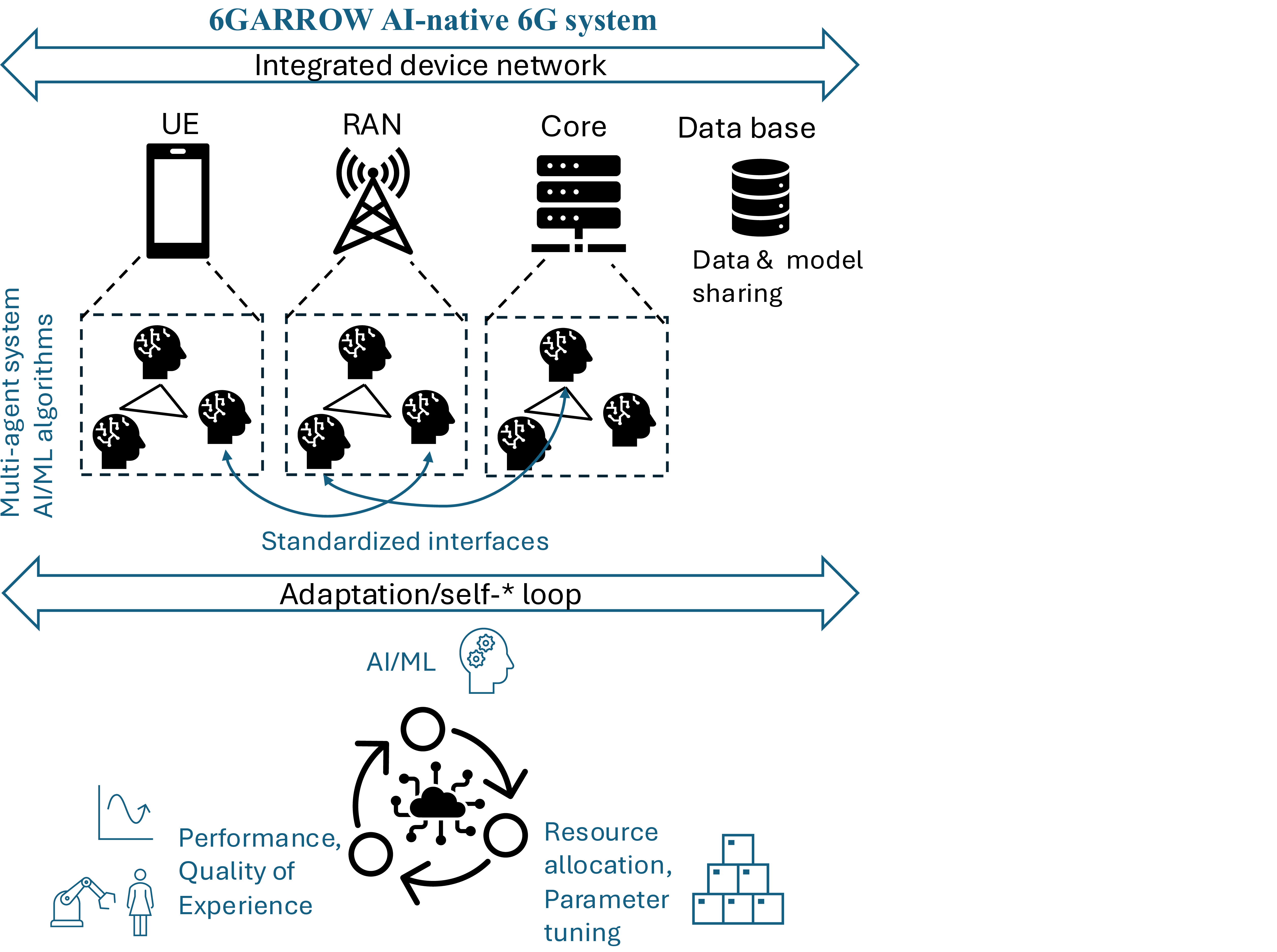
6GARROW System Architecture
The 6GARROW AI-native system architecture, illustrated in Fig. 1, is designed to integrate AI and ML across the entire 6G network, enabling intelligent, adaptive and context-aware operations. The architecture consists of three primary components: The User Equipment (UE), the RAN, and the CN, which together form an integrated device-network system for 6G. Built on standardized interfaces, the architecture facilitates seamless communication between these components. UEs, including mobile devices and Internet of Things (IoT) nodes, interact with the RAN, which provides the necessary infrastructure to connect the UEs to the CN, responsible for global data routing and resource management. Each component operates its own local AI/ML models, with distributed agents embedded across the system.
A key aspect of the 6GARROW architecture is intra-network data collection and sharing. All network components, including user devices, RAN equipment, and CN functions, are equipped with data collection mechanisms. This data is shared with intelligent network components such as the 5G Network Data Analytics Function (NWDAF), the Management Data Analytics Function (MDAF), or the RAN Intelligent Controller (RIC) to optimize network operations and ensure that operational data is readily available for decision-making processes. Data and analytics derived from this information are exposed to network management and orchestration systems via management Application Programming Interfaces (APIs) or specialized functionalities like the Network Exposure Function (NEF) found in 5G architectures. This enables advanced service placement and instantiation mechanisms that span multiple domains, providing external applications with a level of customization for the 6G network. AI nativeness within the architecture ensures low-latency, ubiquitous access to intelligence by densifying user-plane “exit points” near data network locations at the edge and implementing intelligent traffic local breakout mechanisms. This approach enhances network responsiveness and performance, particularly for latency-sensitive applications.
Furthermore, by incorporating AI at the core of network management, the 6GARROW solution simplifies daily operations and creates new opportunities for monetization, such as AI as a Service (AIaaS). AIaaS enables a wide range of users, including mobile subscribers, machines, third-party applications, and interconnected networks, to access AI models directly through the network. However, this approach introduces several challenges that must be addressed, such as life-cycle management, orchestration, API definition and exposure, protocol standardization, EE, and data management.
In addition, 6GARROW is designed to support the emerging paradigm of semantic communication and sensing services by exposing AI/ML resources and datasets to external devices and users. This approach facilitates system-wide optimization, not only enhancing local optimization tasks but also providing external devices and users access to a virtually limitless pool of AI/ML resources and related training datasets. This integration allows for greater scalability and flexibility in delivering intelligent services.
Through dedicated research in business modeling, 6G-ARROW seeks to empower verticals to innovate more effectively by implementing AI-driven services. This approach aims to align technical innovation with market-driven strategies, fostering tailored solutions and accelerating adoption in diverse industries.
Research on Innovative Technology Enablers
Interfaces and signaling
6GARROW will delve into the impact of wireless environments on federated learning performance and develop advanced transmission and reception techniques to mitigate these effects and enhance learning outcomes. This includes exploring how 5G State of the Art (SotA) RAN architectures, like massive Multiple-Input Multiple-Output (MIMO), can facilitate federated learning in scenarios where devices lack Channel State Information (CSI). The project will design efficient resource allocation and device scheduling algorithms that optimize distributed learning performance in wireless networks, considering factors such as communication efficiency, computational capabilities, and data heterogeneity. Semantic communications will be employed to prioritize essential information to user applications, maintaining vision task accuracy under wireless channel conditions. Furthermore, 6GARROW will study compression algorithms for CSI at the UE and reconstruction algorithms at the Base Station (BS) based on AI/ML, enabling precise and reactive selection of Modulation and Coding Scheme (MCS) for each time-frequency resource block. The project will define signaling supporting AIaaS APIs within the network and externally, allowing network internal AI computation and related training data to be accessed by external users. Lastly, 6GARROW will explore cross-layer optimization for semantic communication integration, including the concept of a “semantic plane” and the definition of “semantic interfaces” between the application layer and lower protocol stack layers.
AI/ML-enhanced device performance
Automation and Optimization of Terminal Traffic
6GARROW will explore semantic communications by jointly optimizing traffic generation and data transmission, requiring a rethinking of conventional data arrival assumptions. To enable this in addition to the new “semantic interfaces” 6GARROW will leverage semantic and goal-oriented3 data representation techniques to adaptively enrich data and extend their multi-modal interoperability, enabling adaptive Physical Layer (PHY) and resource allocation techniques. The project will define metrics and information to be provided by the application layers for transmitter and receiver, and study the impact of semantic communication services on communication performances. In the context of 6G, semantic communication services are envisioned to enable tailored connection specialization for diverse end-user applications. However, the strict delineation between application and transport layers in generalist networks presents a challenge. To address this, 6GARROW will explore establishing an interface between these layers, allowing the application to provide suitable metrics and information to the network for transporting semantic data, while adhering to privacy regulations like the General Data Protection Regulation (GDPR). This work will lay out the basis for semantic Service Level Agreement (SLA), as first introduced in [6]. The project will also study the types of semantic processing that can be implemented based on available data and evaluate the impact of missing metrics on performance.
Enhancing Terminal Energy Efficiency
6GARROW aims to leverage semantic communications to reduce data transmission by identifying and extracting necessary information for the task. As the notion of essential information depends on the communication context, it will explore context formulation and application, algorithms for data condensation, and the impact of context drift on system performance. Once the semantic data has been provided by the application as a latent space representation (embeddings), the deployment of tailored codec could compress this structured continuous space. Additionally, 6GARROW will pioneer a multi-toolbox approach to enhance terminal EE in wireless networks, integrating AI/ML models across different protocol layers and network entities. The project will also investigate device-edge co-inference, semantic-aware wireless cognition, and the use of semantic and goal-oriented AI/ML techniques for data selection, interpretation, and compression. Furthermore, 6GARROW will explore AI/ML optimizations for L1 and L2 layers, as well as optimization techniques for AI/ML assisted architecture in mobile terminals, including Lyapunov optimization and reinforcement learning. Moreover, capabilities of the recent strides in generative AI, such as diffusion models, can be leveraged to reduce the amount of data that needs to be transmitted. This will allow a balance in computation and communication, where the generative models at the receiver can recover from the minimal information sent from the terminal by utilizing semantic segmentation and scene understanding. Limited energy is available in the terminal, which calls for energy-efficient waveforms, especially in the Uplink (UL). Therefore, an energy-efficient waveform design combined with coded modulation targeted at the UL will be considered in the project. Both single and multi-carrier waveforms are explored, along with possible Hardware (HW) and channel effects. The solution approach will be based on model-based end-to-end learning under EE targeted constraints.
AI/ML-enabled Simplification of Terminal Hardware
6GARROW will explore AI-assisted HW impairment mitigation aiming for improved performance and EE. This will include addressing Power Amplifier (PA) non-linearity, first by using AI/ML techniques for PA behavioral modeling and then with Digital Pre-Distortion (DPD). The existing polynomial-based methods have the limitation of lack of modeling accuracy, which is pronounced in wideband scenarios when high nonlinear memory effects are present. Recent literature has shown that AI-based DPD techniques have shown much better modeling performance and linearization capability [7]. However, the complexity of these models is a concern with respect to HW implementation. Therefore, the focus is to reduce the complexity of existing AI-based DPD techniques by combining conventional polynomial/filtering and AI-based approaches based on the physical characteristics of the PA behavior leading to a simplified but robust DPD. Furthermore, existing DPD algorithms are highly sensitive to variations in PA conditions, requiring frequent retraining due to factors like temperature, input power, and signal bandwidth changes. Developing robust DPD algorithms and employing adaptation techniques like transfer learning can reduce training complexity while maintaining effective performance in dynamic environments. DPoD is another key approach to further enhance the transmitter impairment compensation on the receiver side. In high-frequency situations, array PAs may cause distortions that cannot be compensated on the transmitter side alone, which will be investigated in 6GARROW. The project will also investigate the implementation aspects of device-edge co-inference, focusing on efficient embedding of sensing, semantic encoding, and communication functionalities on the device. Additionally, 6GARROW will explore various AI/ML approaches to enhance 6G network performance, including CSI framework optimization, beam management, positioning, and demodulation optimization.
AI/ML solutions for optimized RAN and Core
AI-Driven Core and Radio Resource Management and Energy Efficiency
6GARROW aims to enhance EE in 6G networks through AI-enabled automation of various network functionalities. The project will analyze AI-enabled utility functions to identify potential new energy-optimized processing services and ensure EE of the overall network. Additionally, 6GARROW will investigate advanced management and orchestration mechanisms for complex network topologies, including the integration of transfer learning with reinforcement learning to optimize EE in the 6G core. The project will also explore AI-driven solutions for core and wireless resource management, improving RAN performance, and building on the existing Service-Based-Architecture to provide AI/ML services centrally and externally.
Automated RAN & Core management and Network Failure Recovery
6GARROW aims to enhance network efficiency and robustness through AI-driven innovations. By utilizing generative AI models, the project will create wireless channel twins for accurate simulation and prediction, and employ AI-native RAN configurations with Radio Unit (RU)-Distributed Unit (DU) fronthaul data compression techniques. Additionally, 6GARROW will explore real-time cooperative beamforming optimization and advanced twin-based massive MIMO beamforming design. The project will also focus on AI-based resource allocation and service optimization, intelligent robustness and recovery mechanisms for CN functions, and cross-domain inference coordination and integrated reconstruction technology.
To make the targeted innovations reality, advanced orchestration solutions need to be able to gather data from all available sources: from the PHY, from the virtualization layer, from the user and control planes, from 3GPP-defined network functions, and from their vendor-specific software-level implementations. 6GARROW aims at tackling the challenge of jointly collecting and processing such heterogeneous data towards a holistic and resilient resource management. This can be effectively achieved only via a highly distributed and low-footprint AI/ML infrastructure, tightly integrated with the architecture of the mobile network and spread across RAN and CN.
Demonstrations & Proof of Concept
In current testbeds and experimentation platforms, AI/ML functionalities are typically restricted to individual signal processing modules (i.e., are used locally to address a well-defined specific need) or are added on top of the networking stack. The implemented models are typically stand-alone, with no online end-to-end optimization process. Going beyond the current SotA, 6GARROW will demonstrate key architectural innovations and will validate novel AI/ML solutions for enhanced device performance and optimized RAN and Core.
Functional demonstrations
6GARROW will showcase its innovative technologies through four functional demonstrations, highlighting the potential of AI-native and integrated device-network approaches in 6G wireless communication, and illustrating the practical benefits of the technologies developed in the project.
Semantic-aware device-edge co-inference
device-edge co-inference with semantic-aware encoding and inference, using a testbed for edge intelligence apps. It features gesture recognition in a robotic control setup, with learning done end-to-end. The demonstration aims to popularize 6G applications by showcasing practical advancements like a smart robot providing real-time, personalized feedback.
6G cross-domain network intelligence framework
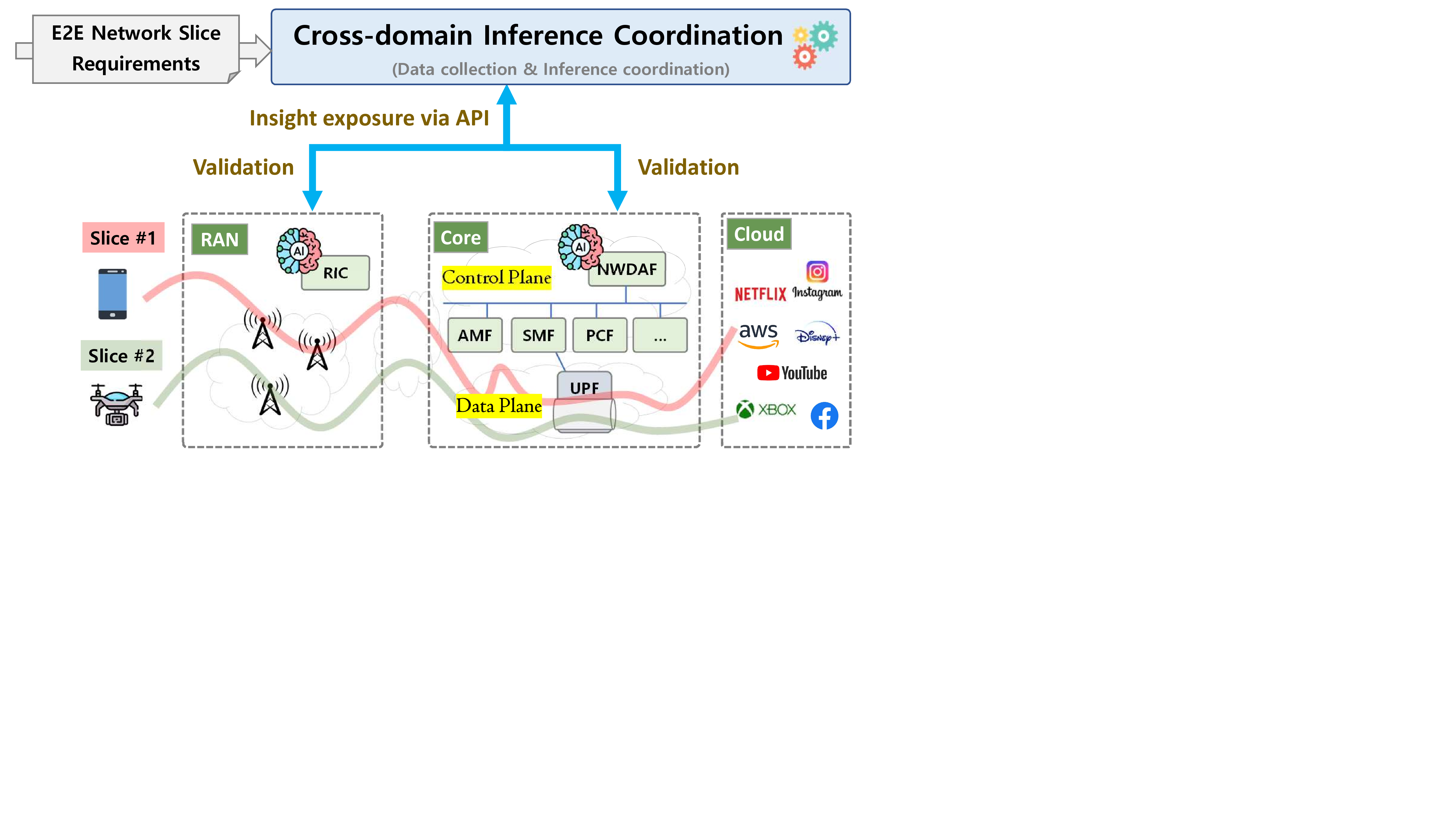
cross-domain AI coordination for End-to-End (E2E) network slicing. It showcases AI capabilities in RAN and CN domains, along with a cross-domain inference coordination function to validate slice requirements and resolve potential conflicts. Key components include network analytics functions in both domains, exposed slice analytics, and the coordination function to ensure E2E network slice requirements are met.
Physical layer AI/ML techniques
this third demonstration will evaluate AI/ML PHY techniques, such as CSI feedback, beam management, using O-RAN components Open-RU and Open-DU in a lab setting. It validates AI/ML algorithms’ performance and efficiency in realistic network environments, promoting flexibility and interoperability. The demonstration aims to intelligently and efficiently utilize limited radio resources.
AI/ML based CSI and CQI compression
validates AI/ML-based CSI & Channel Quality Indicator (CQI) compression algorithms on an edge intelligence platform. Using an enhanced MIMO testbed with RFSoC and GPU, the demonstration assesses algorithm performance with field channel measurements.
Proof of concept
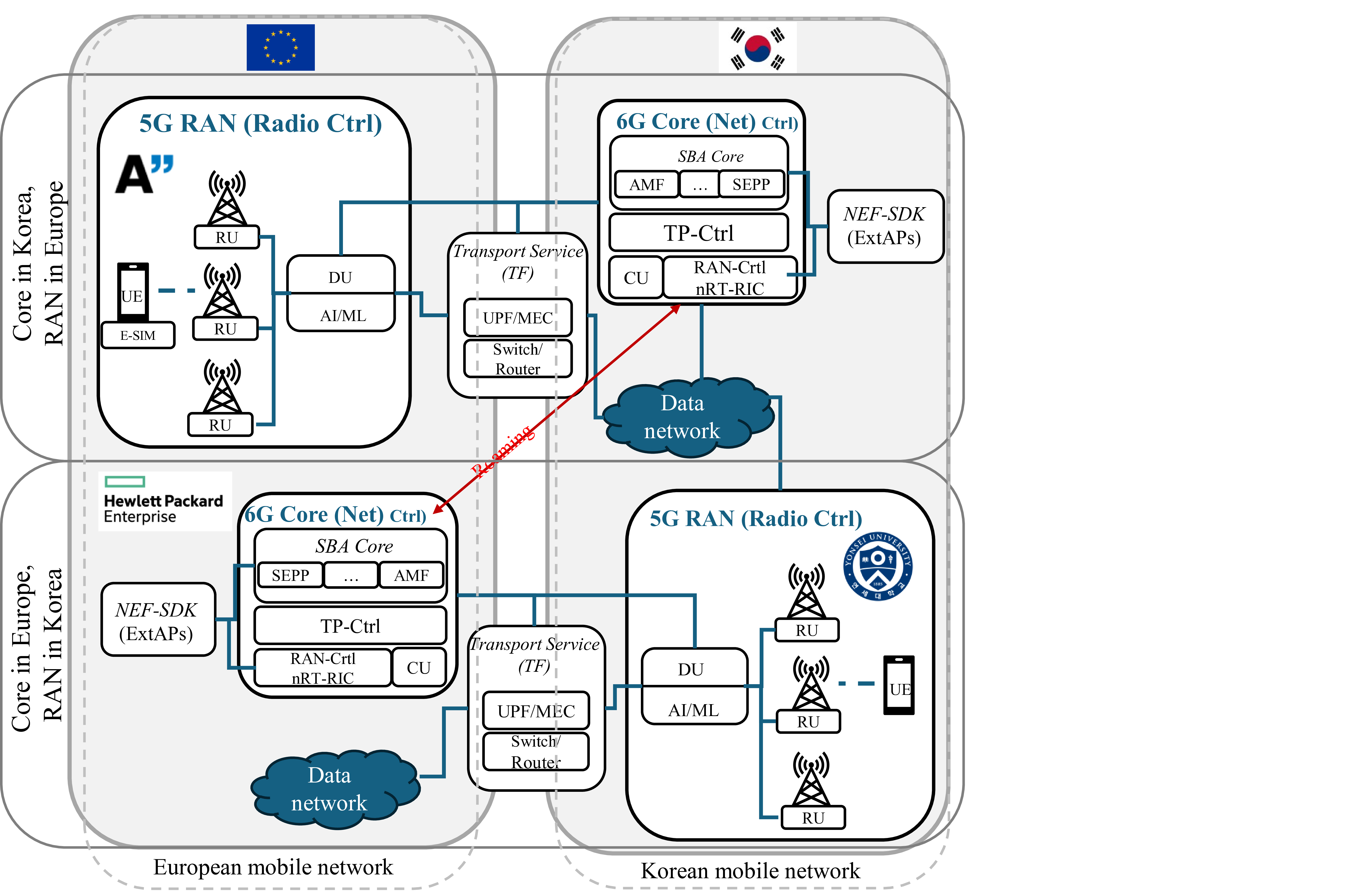
Overstepping these functional demonstration and validation, a Proof of Concept (PoC) will be developed to showcase an AI-enhanced network where AI functionalities are integrated across all domains (device, RAN, and CN), Fig. 3. The PoC will rely on a cross-continental setup with advanced mobile network components - such as the HPE Aruba Networking Private 5G CN. In addition, the PoC will demonstrate advanced orchestration of network functions such as fronthaul/backhaul management, authentication, and user management, while enabling an open interface for customer-driven application development, implementation, integration and testing of testbeds for functional demonstrations.
European Regulatory and Market Landscape
The European Commission, the European Parliament and the European Council are currently in the process of substantially revising access requirements to the EU Single Market. Among other initiatives, key new regulations include EU AI Act [8], the EU Data Act [9] and the European Cyber Resilience Act (CRA) [10]. 6GARROW will consider those novel requirements such that future AI-enabled 6G systems will inherently meet the novel requirements and thus have immediate access to the EU Single Market. It is indeed a brilliant opportunity for 6GARROW to influence the implementation of those regulations through participation to the development of so-called Harmonised European Norms (HEN). These are special types of standards to be developed by the European Standardisation Organisationss (ESOs) ETSI, CEN and CENELEC which will provide presumption of conformity to the essential requirements of the respective regulations - once the HEN have undergone appropriate scrutiny by the European National Standards Bodies and the European Commission and have been published in the EU Official Journal. In this space, specific focus areas of 6GARROW are as follows:
Meeting requirements in General Purpose Artificial Intelligence (GPAI) Models of systemic and requirements of high-risk AI Systems according to the EU AI Act, specifically related to safety components of 6G AI-enabled systems; those requirements are indeed the main focus on the EU AI Act;
Meeting Cybersecurity related requirements, especially focusing on the mitigation of risk over the lifetime of a future 6G network and all related components according to the CRA;
Meeting Data management requirements as introduced by the European Data Act including enabling users to access data managed by a Data Holder, such as a 6G network mobile operator for example, to request the transfer of data to a third party, facilitating data interoperability, etc.
The related European legislative initiatives are expected to have a substantial influence on related debates in all regions. Only recently, South Korea took a related initiative by passing the Basic Law on the Development of Artificial Intelligence. Thus, it is a unique opportunity to exchange views and a technology solution with the Korean partners of the 6GARROW consortium.
Conclusions
The 6GARROW project represents a transformative leap toward the realization of AI-native 6G networks, seamlessly integrating AI/ML technologies into every facet of wireless communication systems. By adopting a holistic approach that encompasses AI-native architectures, integrated device-network frameworks, and interdisciplinary methodologies, the project aims to overcome the limitations of current network technologies and set new standards for automation, efficiency, and scalability. Through innovative system architectures, such as AI-enhanced RAN and CN, alongside pioneering methods like semantic communications and energy-efficient design, 6GARROW positions itself as a catalyst for future innovations. The project’s emphasis on interdisciplinary collaboration, regulatory compliance, and robust performance indicators ensures that the developed solutions are not only technically superior but also aligned with evolving market and legislative demands.
An AI-native system is an architecture where AI constitutes a fundamental design principle rather than an auxiliary component. The system’s core functionalities inherently rely on AI processing for their basic operations, with intelligence embedded as a native feature across all system layers and components.↩︎
Semantic communications constitute a communication framework where information is transmitted through embeddings high-dimensional vectors that encode concepts in a continuous space enabling meaning-preserving exchanges based on shared semantic understanding rather than bit-level accuracy.↩︎
Goal-oriented communications constitute a task-driven communication framework where the transmission strategy is optimized to achieve specific objectives. This paradigm evaluates communication effectiveness through task completion metrics, adapting the information exchange process to maximize the probability of reaching desired outcomes.↩︎