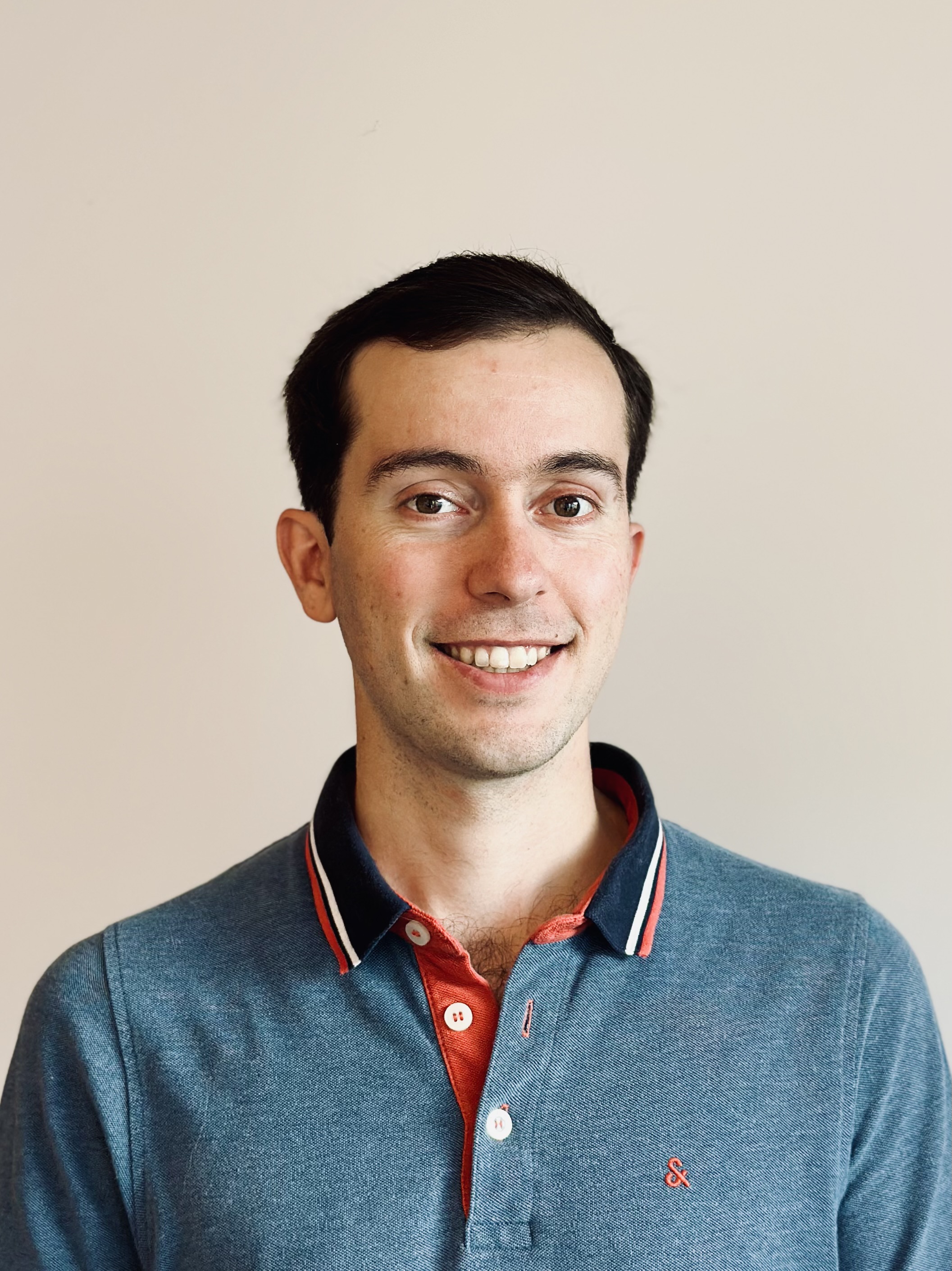
Guillaume Larue
Senior Research Scientist
Ph.D., Institut Polytechnique de Paris
AI Systems, Networking & ML Research
Senior Research Scientist with 9+ years of industrial R&D experience at the intersection of AI systems, networking, and machine learning. PhD from Institut Polytechnique de Paris, publications at ICML and IEEE Transactions on Communications, 25+ filed patents. After earlier work across embedded systems and ML for wireless communications, I now focus on AI-native networking and semantic communications for AI agents.
My work connects practical ML methods and learning theory with the deployment constraints of real-world communication systems. I currently study the future communication layer for distributed AI agents: efficient embedding transport, compression, alignment between heterogeneous AI models, and deployable semantic communication mechanisms. I also work on ML foundations for structured learning, with recent work accepted at ICML 2026.
Part of the founding research team of the joint Orange x CEA "AI-Native Communications" laboratory, and contributor to EU projects including 6G-DISAC and 6G-ARROW. My work feeds into IP strategy, standardization positioning, and long-term research direction.
I mentor young researchers, present to broad audiences, and engage with senior leadership on where to place scientific bets. I especially enjoy working with curious teams to turn early research ideas into ambitious research paths. Outside research, I enjoy mountain hikes, cycling, sailing trips, and music.
Impact at a Glance
Research Themes
ML Theory & Structured Learning
Structured learning problems, neural architectures, convergence guarantees, and optimization methods motivated by communications, coding, and systems constraints.
Semantic & Agentic Communications
Protocols and representations enabling AI agents and heterogeneous models to exchange meaning directly, including embedding transport, compression, alignment, and semantic-aware network services.
ML & Signal Processing for Networks
Machine learning and signal processing for communication networks: neural decoders, learned coding mechanisms, ISAC, and digital-twin world models for spatial inference.
Latest Publications

How Far Do Simple Transformations Translate Across Text Embedding Models?
Sid Ali Hamideche, Louis-Adrien Dufrène, Quentin Lampin, Guillaume Larue
August 06, 2026 — arXiv preprint
We investigate whether simple transformations can translate representations across heterogeneous text embedding models. Understanding how independently trained models organize semantic information is an enabler for AI-to-AI latent communication without decoding into human-readable text. Focusing on lightweight translators such as linear mappings, we test the literature hypothesis of latent universality in a realistic text setting beyond simplified benchmarks. Across nine embedding models differing in architecture, pooling strategy, and training objective, we evaluate compatibility using CKA, downstream transfer, fidelity, and retrieval. Simple translators recover meaningful shared structure and support transfer for some compatible pairs, but fail sharply for others. Compatibility depends jointly on architecture, training objective, pooling, and data distribution. Overall, the results show that heterogeneous embedding spaces are not universally related by simple mappings as often suggested in some literature.

Learning Compression Rules for Network Traffic
Quentin Lampin, Éloi Sainte-Beuve, Louis-Adrien Dufrène, Guillaume Larue, Massih-Reza Amini
August 05, 2026 — arXiv preprint
We study the problem of learning compact rule-based compressors for structured network traffic. Each packet is a record of header fields that are highly redundant within a flow, and a compressor is a small set of rules matching such records and replacing predictable fields with short codes. We cast rule learning as a two-stage problem: (i) an unsupervised structure-discovery stage that recursively partitions training packets using a normalized entropy-ratio criterion robust to small samples, and (ii) a constrained selection stage that uses dynamic programming to pick the rule subset maximizing expected compression gain under a hard budget on the number of installable rules. We instantiate the framework on Static Context Header Compression (SCHC), the IETF standard for rule-based header compression in constrained networks, and evaluate it on four real-world Internet-of-Things and 5G core-network datasets. Our method, Robust Entropy Clustering for Adaptive comPression (RECAP), surpasses expert-engineered rule sets with a small number of learned rules and removes the need for manual rule design.

Learning High-Dimensional Parity Functions with Product Networks using Gradient Descent
Guillaume Larue, Louis-Adrien Dufrène, Quentin Lampin, Hadi Ghauch, Ghaya Rekaya
May 30, 2026 — ICML 2026 (accepted, to appear)
Parity functions are fundamental Boolean operations with critical applications across machine learning, cryptography, and error correction. Yet, learning high-dimensional parity functions poses significant challenges: in a general setting, standard neural network architectures typically require exponential sample complexity, making gradient-based optimization intractable for large number of inputs $N$. We demonstrate that compact product-based neural architectures combined with stochastic data sparsity (Bernoulli inputs with $p_e \leq 1/N$) and appropriate hyperparameter choice enable efficient parity learning, with theoretical guarantees of convergence. Experiments validate our theory across dimensions up to $N = 100{,}000$, with empirical evidence showing optimal hyperparameter choices for $p_e$ and learning rate $\alpha$, as well as polynomial complexity scaling laws. This work establishes fundamental connections between architectural inductive bias and data sparsity, opening new possibilities for neural arithmetic, structured reasoning, binary neural networks, and machine learning applied to automated protocol discovery.
People & Mentoring
Mona Dhiflaoui
SupervisorCurrent role: Machine Learning Engineer @Kaizen Solutions
Matthieu Dubois
AdvisorCurrent role: PhD Candidate, CNRS and Sorbonne Université
Eloi Sainte-Beuve
SupervisorCurrent role: PhD Candidate, Université Grenoble Alpes and Orange
Eloi Sainte-Beuve
SupervisorIgor Palhano
SupervisorLeonardo Roque
AdvisorSid Ali Hamideche
AdvisorSupervisor Official (co)supervisor · Advisor Active involvement in research discussions, meetings & co-authorship